Free Download The Knowledge: How to Rebuild Civilization in the Aftermath of a Cataclysm
So, this is exactly what this book uses to you. You may take no notice of this info about The Knowledge: How To Rebuild Civilization In The Aftermath Of A Cataclysm Ignoring the benefits of this book will certainly escort you to regret. Yeah, the advantages of reading this book will certainly be exact same with others. Enhancing the experience, understanding, and ideas are the common means of you to read some publications. However, the in addition, the advantages will certainly be shown from each book when analysis and also finishing it.
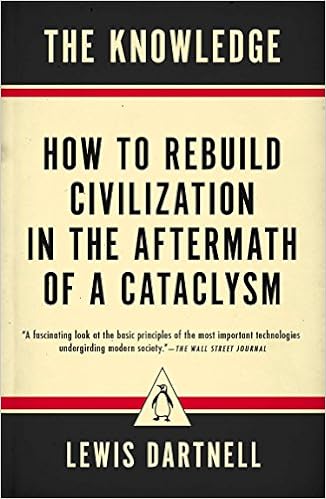
The Knowledge: How to Rebuild Civilization in the Aftermath of a Cataclysm

Free Download The Knowledge: How to Rebuild Civilization in the Aftermath of a Cataclysm
Now, welcome the book seller that will certainly become the very best seller book today. This is it book. You may not really feel that you are not knowledgeable about this book, may you? Yeah, almost everyone learns about this book. It will certainly likewise go through exactly how guide is really supplied. When you can make the possibility of guide with the good one, you can pick it based upon the reason and recommendation of just how the book will certainly be.
This publication includes the distinct taste of the book composed. The specialist author of this The Knowledge: How To Rebuild Civilization In The Aftermath Of A Cataclysm has typically makes a fantastic book. However, that's not just around fantastic book. This is additionally the problem in which the book provides very intriguing products to get over. When you really wish to see exactly how this book is offered as well as offered, you can sign up with a lot more with us. We will certainly offer you the link of this book soft file.
As related to this referred book, you might have understood why this book is awaited. Yet, for you who are still curious of the factors, you will realize he reasons when you start to check out the book. Taking a look at the cover of The Knowledge: How To Rebuild Civilization In The Aftermath Of A Cataclysm and also read title will lead you understand why lots of people falling in love. Keen on guide that pertaining to the topic you are looking for can make you really feel pleased. This is exactly what will certainly make you fill that desire.
So currently, just what's more you will go through with this publication? Just get The Knowledge: How To Rebuild Civilization In The Aftermath Of A Cataclysm asap to lead your thought to always create. When you make small way of thinking to think of difficult book to read, you will certainly not make any type of development. And also see just what you will certainly obtain, be sorry for will certainly constantly come behind. So, do you want to turn into one of them? Naturally not! Reviewing and also reviewing become one of the choices that you can try to conquer the problems.
Human knowledge is collective, distributed across the population. It has built on itself for centuries, becoming vast and increasingly specialized. Most of us are ignorant about the fundamental principles of the civilization that supports us, happily utilizing the latest—or even the most basic—technology without having the slightest idea of why it works or how it came to be. If you had to go back to absolute basics, like some sort of postcataclysmic Robinson Crusoe, would you know how to re-create an internal combustion engine, put together a microscope, get metals out of rock, or even how to produce food for yourself?
Lewis Dartnell proposes that the key to preserving civilization in an apocalyptic scenario is to provide a quickstart guide, adapted to cataclysmic circumstances. The Knowledge describes many of the modern technologies we employ, but first it explains the fundamentals upon which they are built. Every piece of technology rests on an enormous support network of other technologies, all interlinked and mutually dependent. You can’t hope to build a radio, for example, without understanding how to acquire the raw materials it requires, as well as generate the electricity needed to run it. But Dartnell doesn’t just provide specific information for starting over; he also reveals the greatest invention of them all—the phenomenal knowledge-generating machine that is the scientific method itself.
The Knowledge is a brilliantly original guide to the fundamentals of science and how it built our modern world.
Product details
Paperback: 352 pages
Publisher: Penguin Books; Reprint edition (March 10, 2015)
Language: English
ISBN-10: 0143127047
ISBN-13: 978-0143127048
Product Dimensions:
5.4 x 0.8 x 8.3 inches
Shipping Weight: 10.4 ounces (View shipping rates and policies)
Average Customer Review:
4.2 out of 5 stars
186 customer reviews
Amazon Best Sellers Rank:
#31,476 in Books (See Top 100 in Books)
The author clearly states he is not writing a "survival guide". So in a way he does what he intends to do, he has written a book which mentions a lot of concepts that were important in the advancement of civilization. In some ways this is more of a history book than anything else. Just knowing about a concept is a big step toward actually being able to reinvent it.The nitty gritty details are almost never mentioned. This is not a "how to" book at all. And this gets to my main point, each chapter really should be a book unto itself. A single *short* book can not hope to cover this subject matter.My guess is that from the title, the primary people who will be attracted to this book are "preppers" but unfortunately there is very little of value for a prepper. And if we really want a "Library of Alexandria" which will survive a disaster and guide us to rebuilding then it just plain has to be more than a single book that skims over a lot of interesting concepts.I'm also disappointed that the book doesn't make more of an effort to discuss avoiding the mistakes we have made. Conventional, traditional farming is one chapter ("Agriculture"). Perhaps it would have been wiser to discuss the mistakes of conventional farming and point out the merits of sustainable agriculture as an alternative model?Amusing reading? Yes. Practical advice? Not really.Don't get me wrong, there are some really cool tidbits mentioned in this book and it has not been a complete waste of time to read it. In particular I really liked the mention of the "absorption refrigerator" which sounds like a great energy efficient approach to cooling instead of our energy hungry compressors.American readers might be a little unsettled at this very much England centered viewpoint. (which I actually found a refreshing and charming point of view)If all other knowledge is lost and a human discovers this book 100 years from now (assuming they still know how to read English), the concepts will be inspirational and may accelerate rebuilding of society.
What I was looking for was a book about 'how to rebuild our world from scratch'.A series of 'this is how to build a fire', 'this is how to identify iron-bearing rocks', 'this is how to smelt iron', 'this is how to build a steam engine, etc.The book instead is a series of chapters describing problems that one facing the rebuilding of civilization would face with no solutions. For example it describes how post-1800s farming requires industrial nitrogen fixing and how not having that is an issue, without providing a solution.This book is a good starting point for research, but is not what I was hoping for.
This is a pretty good book. Entertaining, a good light treatment of the topic...And the lightness is my main problem. Everything is covered in to shallow a depth, the author doesn't explore any one topic in sufficient detail, and the end result is...Well. The author comes out (towards the end) and says this is a thinly disguised popular science popularization, rather than a flawed-but-serious attempt to do what the book is marketed to do.So... the marketing is hyperbolic, and a huge let-down. Maybe pick up if this one's under $4.00 on sale, or buy for a precocious 12 year old, rather than an adult with a strong technical background.This would make a better TV show than a book.
Well written and fascinating. I read it cover to cover. I put it next to my throne and it captivated me unreservedly! I don't plan to rebuild civilization anytime soon, but I enjoyed discovering how the scientific principles of our complex industrial world were discovered, and then learning how the technology was developed that underlies modern civilization.I'm filled with awe at the brilliant people who have built our modern civilization.I heartily recommend this book to anyone who wants to understand how the things we take for granted actually work, or who wish to appreciate what amazing ingenuity went into developing our present civilization.I bought a copy and sent it to my brother, who also reported enjoying it.
This is a very informative book with a lot of fascinating detail. It is basically a thought experiment. If most of humanity was wiped out in the morning and a handful of people remained, could they survive and rebuild modern technology? To determine this, Dartnell looks how these technologies were originally developed and any possible short cuts which the survivors could take.The ‘apocalypse’ itself described in book was very clinical but this book is not meant to be a blow-by-blow instruction manual. I couldn’t see survivors sitting around it deciding what to do on Day 24. However, it does contain a lot of high level technological insight that a post-apocalyptic Edison or Pasteur might find useful and could spend years of their lives trying to leverage.The book is apolitical. Its focus is the technology. If you need advice on how to hang on to your post-apocalyptic fiefdom, consult Machiavelli, Sun Tzu and other experts in such matters. Oh, the book doesn’t cover killing zombies either.Some readers might find the advanced chemistry section a bit of a drudge, but I can’t see how Dartnell could avoid that, given leaving it out would undermine the book’s purpose. On the flip side, it provides useful context for any fledgling chemistry students.The footnotes throughout the book are consistently very interesting. I think any writer interested in world building would find the book very useful.One thing to note is that the book is shorter than it appears. About the last 20% is filled with references, including a useful list of relevant fiction.One final word of advice. If you want to tuck this away for the apocalypse, so you can amaze the other survivors with your scientific knowhow, remember to buy the paperback, not the ebook. Unless you’re really sure you can get those generators up and running.
The Knowledge: How to Rebuild Civilization in the Aftermath of a Cataclysm PDF
The Knowledge: How to Rebuild Civilization in the Aftermath of a Cataclysm EPub
The Knowledge: How to Rebuild Civilization in the Aftermath of a Cataclysm Doc
The Knowledge: How to Rebuild Civilization in the Aftermath of a Cataclysm iBooks
The Knowledge: How to Rebuild Civilization in the Aftermath of a Cataclysm rtf
The Knowledge: How to Rebuild Civilization in the Aftermath of a Cataclysm Mobipocket
The Knowledge: How to Rebuild Civilization in the Aftermath of a Cataclysm Kindle